
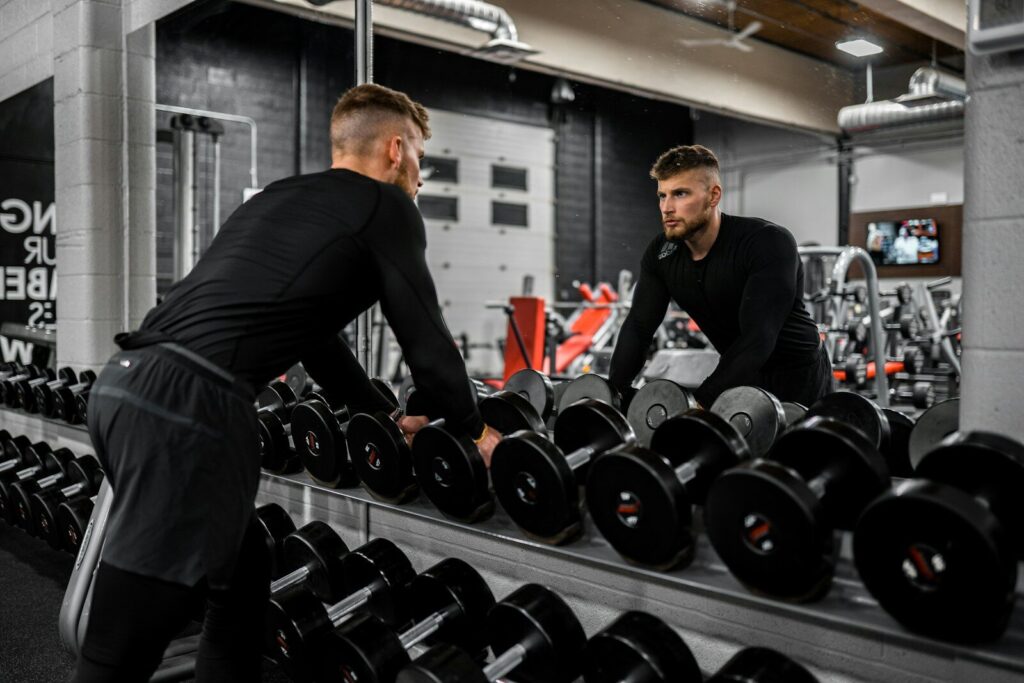
If you have just started training, it is normal to wonder: weights or cardio? In this article, we will analyze which gym routine for beginners is the most effective for you. It is the moment of truth: you have left your backpack in the locker, put on your sneakers, and you are standing in front of the gym map. To your left, an iron temple with dumbbells, barbells, and pulleys. To your right, an endless row of treadmills. The big doubt hits you right in the face: Where do I start?
The Error of “Total Separation” in Training
For decades, we have been sold the idea that the gym is a place where you choose a faction: either you are one of those who run, or you are one of those who lift iron. As if they were disciplines that repel each other. The reality is that they are two tools that enhance one another. For someone who is learning how to start at the gym, the goal is not short-term “weight loss,” but building a solid foundation.

What Actually Happens When You Do Cardio?
Cardiovascular training (running, cycling, rowing) is the language of your heart and your lungs. When you do cardio, you are training your engine.
- Immediate advantages: It improves circulation and reduces fatigue in daily activities.
- The health factor: If your heart is efficient, you will get less tired during your strength sessions.
- The trap: If you only do cardio, you miss the opportunity to improve your body composition (losing fat while maintaining muscle).
What Actually Happens When You Lift Weights?
Strength training is the language of your muscles and your bones. When you lift a weight, you send a clear signal: “I need to be stronger to survive.”
- The “Metabolic Effect”: Unlike cardio, which burns calories in the moment, weights keep burning energy for hours because your body is repairing muscle fibers.
- Bone density: Lifting weights is the best medicine against future weakness. You strengthen your tendons and your bone structure.
The “Hybrid” Strategy: The Key to Gaining Muscle as a Beginner
If you are looking to gain muscle as a beginner or improve your general fitness, do not choose. Combine. The best way to survive is the 70/30 structure:
- 70% Strength: Dedicate most of your time to learning the technique of basic exercises.
- 30% Cardio: Use it as a warm-up or to improve your endurance at the end.
Table: Gym Routine for Beginners (First 4 Weeks)
| Phase | Main Focus | Suggested Activity | Goal |
| Week 1-2 | Adaptation | Machine circuits | Learn the movement |
| Week 3-4 | Controlled strength | Basic free weights | Gain confidence |
| End of session | Light cardio | 15 min of brisk walking | Cardiovascular improvement |
Debunking Myths: Does Cardio Destroy My Muscles?
It is the number one fear. People hear that if they do cardio they will “catabolize.” Relax. That only happens to elite athletes. For a normal person looking to lose fat at the gym or simply stay in shape, doing 20-30 minutes of cardio will not make your muscles disappear. On the contrary, it will give you more energy to train heavy.

How to Choose Based on Your Main Goal?
Although the combination is the winner, you can adjust the balance:
- If you are looking to lose fat: Prioritize strength training to keep your metabolism high and add cardio as an extra to increase total caloric expenditure.
- If you are looking to gain energy: Cardio is your best friend to feel vital, but weights will give you the correct posture.
- If you are a sedentary person: Start with cardio to improve your general physical condition for 15 days, and then introduce weights gradually.
Conclusion: It Is Not What, It Is How
Beyond whether you do weights or cardio, what determines your success is your adherence. The best workout is the one you are capable of repeating week after week. The gym is a tool. Learn to use all of it. Start today, combine both, listen to how your body reacts, and, above all, celebrate that you have already taken the most important step: walking in.
Has the picture become clearer to you? Tell us in the comments which exercise you are most afraid to try.