

Starting your fitness journey might feel complicated at first, but it is easier than you think. You see conflicting advice on social media, complex gym machines that look like spaceship controls, and an endless array of “guaranteed” programs. If you are a beginner, this noise can be paralyzing.
However, the secret to transformation isn’t found in a complicated app or an expensive supplement. You need to focus on what is easy and sustainable. In this guide, we will simplify the process and focus on the pillars that help you build a stronger, healthier version of yourself.
1. The Power of Consistency: More Than Just “Showing Up”
Many beginners think fitness is a sprint. They start by training six days a week, eating only chicken and broccoli, and expecting visible results in a month. When life gets in the way—a busy work week, a sleepless night, or family commitments—they miss a session, feel guilty, and often quit entirely.
Here’s more information: The biggest mistake when starting out (why people quit)
Consistency is not about perfection; it’s about the “average” of your habits over time. Studies suggest that the key to establishing new habits lies in constant repetition and frequency, rather than the level of effort applied in a single session. If you are just starting out, focus on a schedule that is easy to stick to.
- Start small: Committing to 3 days a week is better than committing to 5 and failing.
- The 80% Rule: If you hit your goal 80% of the time, you are doing great. You don’t need perfection; sustainability is what matters.
- Habit Stacking: Adjust your training to an existing habit. A little trick: when I take off my work clothes, I immediately put on my gym clothes, straight away.

2. Progressive Overload: The Secret Mechanism of Growth
If you lift the same weight for a year, your body will adapt to that stimulus and stop changing. This is why many people plateau early on. The essential strategy to break through this physiological plateau is called Progressive Overload.
Progressive overload simply means gradually increasing the demand placed on your musculoskeletal system. You don’t need to add 20kg to the bar every day. You can progress by:
- Increasing Weight: Adding 1-2kg to your lifts.
- Increasing Volume: Attempting to perform 10 repetitions when your previous limit was 8.
- Refining Technique: Executing the movement with greater stability and achieving a fuller range of motion.
- Decreasing Rest: Resting 60 seconds instead of 90 between sets.
By tracking your workouts—even in a simple notebook—you ensure that your “future self” is always doing more than before.
3. Full-Body Routine for Beginners
For most beginners, a “Full-Body” routine is the most effective way to learn movement patterns and allow for recovery. Aim for 3 days a week (e.g., Monday, Wednesday, Friday), leaving at least one day of rest in between.
Your Starter Routine
| Exercise | Focus | Sets/Reps | Why it’s important |
| Goblet Squat | Leg/Glute Strength | 3 x 10-12 | Builds lower body power. |
| Push-ups | Chest/Shoulder/Triceps | 3 x to failure | Develops pushing mechanics. |
| Dumbbell Row | Back/Biceps | 3 x 10-12 | Balances pushing with pulling strength. |
| Lunges | Balance/Stability | 3 x 8 per leg | Corrects side-to-side imbalances. |
| Plank | Core Stability | 3 x 30-45 sec | Protects your spine. |
The Importance of Warm-ups and Cool-downs
Many beginners skip the first and last 10 minutes of their gym session, treating them as “optional.” In reality, they are essential for long-term health. A proper warm-up is important to prepare your joints and nervous system for the load.
- Warm-up: Walk lightly or cycle for 5 minutes, and do some dynamic movements like arm circles and leg swings.
- Cool-down: Do not rush out the door after your last set. Spend a few minutes doing static stretching or breathing exercises to help your body recover.
4. Nutrition: Fuel, Not Just Calories
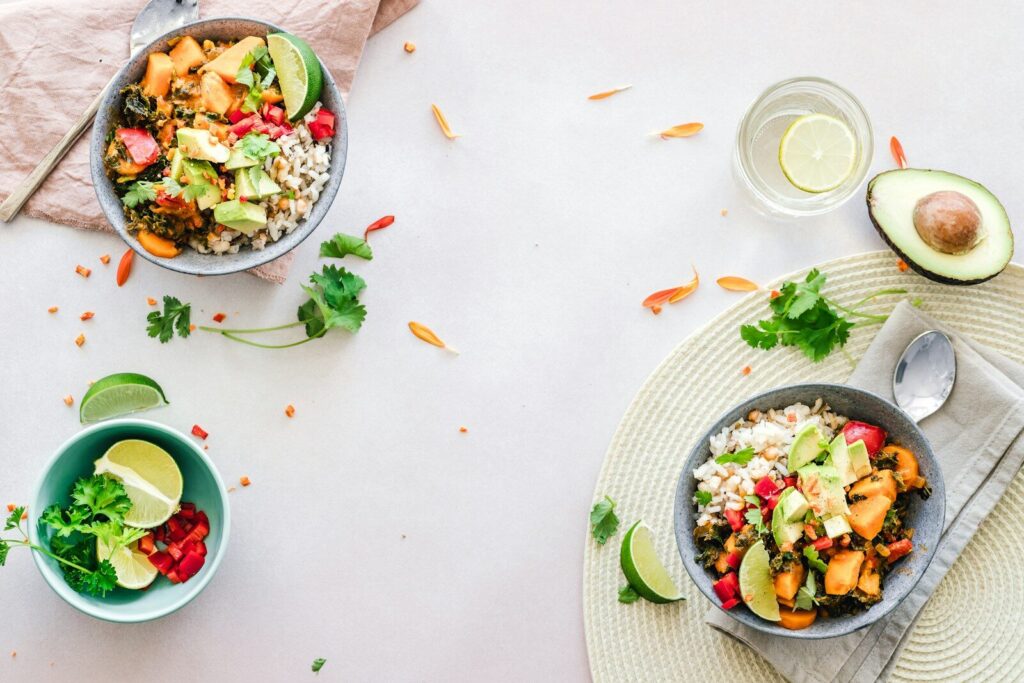
Food is often the most distracting part of fitness for beginners. Forget about “magic” diets. As a beginner, focus on two simple concepts: Protein Intake and Whole Foods.
- Prioritize Protein: Always include protein in your diet; it’s basic and effective. If you are training, try to include a source of protein (chicken, fish, tofu, legumes, eggs, protein powder) in every meal. It keeps you satiated and helps repair muscle tissue.
- 80/20 Approach: Eat nutrient-dense, whole foods 80% of the time. Use the remaining 20% to enjoy the foods you love.
- Hydration: You need to stay hydrated at all times because muscle mass is made up of a lot of water.
Frequently Asked Questions (FAQ)
I’m embarrassed to go to the gym. What do I do?
Keep in mind that everyone goes through this on the first day. Later, you’ll realize that everyone is focused on their own workout and nothing else will matter. Give it time and don’t stop. If you feel anxious, try going during off-peak hours or start with a home program until you gain confidence.
Will I see changes soon?
“Results” are subjective. You will likely feel a boost in energy and better mood fairly soon, but structural changes—like the muscle gain and fat loss we all want—take a bit longer. Just keep training consistently. Patience is part of the process.
Do I need to take something to make progress?
They’re not necessary. As a beginner, your priority is real food. Once you’ve been training consistently for 3-6 months, you can consider basics like protein, but they’re not mandatory. [Read the paragraph in the supplement FAQ here].” (Nutrition Supplements).
What if I miss a workout?
Life happens. If you miss a day, don’t try to “train double” the next day, as this leads to burnout. Simply treat it as a scheduling lesson, accept it, and show up for your next scheduled session.
Conclusion: Start Today
The best time to start was yesterday. The second best time is today. You don’t need the perfect gym shoes, the most expensive watch, or the ideal physique to begin. You only need the will to be there for yourself.
Each time you train, be very focused, and you will improve 1% each time. Track your progress, prioritize your recovery, and keep your nutrition simple. Over the coming months, these small, consistent actions will turn into results you never thought possible.
Are you ready to begin? Let us know in the comments which exercise you find most challenging!