

Thinking that you need a commercial gym membership, expensive machines, or high-end weights to transform your physique is one of the biggest myths in the fitness world. The reality is much simpler: the best tool you have for training is your own body.
Training at home (Home Workouts) doesn’t just save time; it eliminates the logistical barriers that often make us quit. However, for it to work, you need strategy, not improvisation. In this guide, we will learn how to build muscle and strength from your living room.
Why Home Workouts are Highly Effective
Contrary to popular belief, the intensity of a workout does not depend on how much metal you lift, but on the quality of muscle contraction and the effort you exert. Training at home offers unique advantages:
- Time Savings: You eliminate travel time. The time you used to spend going to and from the gym is now extra time for rest or other priorities.
- Comfort Zone: For many beginners, the gym can be intimidating. At home, you can focus 100% on your technique without feeling watched.
- Guaranteed Consistency: As we explored in our previous article on Fitness Foundations: The Master Plan for Beginners, the key to success is consistency. It is much harder to make excuses when your training area is just a few steps from your bedroom.
Creating Your “Workout Sanctuary” (Mental Preparation)
The biggest challenge of working out at home isn’t the lack of equipment; it’s the lack of physical separation between “relaxation mode” and “training mode”. To succeed, you need to create a mental trigger. You don’t need a dedicated home gym room, but you do need a Workout Sanctuary:
- The Physical Trigger: Choose one specific corner of your living room or bedroom. Even if you have to move a coffee table, do it. When you are in that spot, you are training; when you are on the couch, you are resting.
- The Sensory Signal: Use the same playlist or the same pair of shoes every time you train. Over time, your brain will associate that specific music or those shoes with the start of your session, making it easier to switch into “workout mode” even when you feel tired.
Your Home Workout Routine
You don’t need equipment, but you do need a structured plan. This “Full-Body” routine is designed to work all major muscle groups in about 30-40 minutes.
| Exercise | Focus | Sets/Reps | Technical Note |
| Squats | Legs/Glutes | 3 x 15-20 | Keep heels flat on the floor. |
| Push-ups | Chest/Triceps | 3 x to failure | Use knees if necessary. |
| Lunges | Stability/Legs | 3 x 12 (per leg) | Take a wide step for range. |
| Inverted Row | Back/Biceps | 3 x 10-12 | Use a sturdy table or door frame. |
| Plank | Core | 3 x 45-60 sec | Keep back neutral, don’t arch. |
Note: Perform this routine 3 times per week, leaving at least one day of rest between sessions.

The “Progressive Overload” Challenge Without Weights
The main problem with home workouts is that, eventually, the exercises become “easy” because your body adapts. You need to increase the difficulty to progress. How do we apply progressive overload without dumbbells? Here are 3 ways to keep gaining the strength we want:
- Increase the Tempo: Perform the negative phase (the descent) of the exercise slowly, counting for 3 seconds. This increases “time under tension” and triggers muscle growth.
- Reduce Rest: If you usually rest 90 seconds between sets, try reducing it to 60 or 45 seconds. This forces your muscles to recover faster and increases metabolic demand.
- Increase Volume: If you did 3 sets of 10 push-ups last week, try 3 sets of 12 this week. Or better yet, add a fourth set at the end.
The Power of Isometrics (Advanced Variation)
If you’ve mastered the standard bodyweight movements and they no longer feel challenging, you don’t necessarily need heavier weights to keep progressing. You can use Isometric Holds to skyrocket the intensity. Isometrics involve holding a position under tension, which builds incredible stability and strength.
- How to apply it: During your squats, push-ups, or lunges, pause at the point of greatest difficulty (e.g., the bottom of the squat or the lowest point of the push-up) and hold that position for 3 to 5 seconds before completing the repetition.
- Why it works: This forces your muscles to recruit more fibers to maintain control against gravity, significantly increasing the difficulty of the movement without adding a single kilo of external weight.
Building an Accountability Loop
At the gym, the presence of other people creates “social accountability”—it’s harder to skip a set when you’re surrounded by others. At home, it’s just you and your willpower. To replace this, you need to build your own accountability loop:
- Track Publicly (or Digitally): Even if you don’t post on social media, use a shared document, a fitness app, or a simple calendar on your wall where you tick off every session. Seeing a visual “streak” of completed workouts is a powerful psychological motivator.
- The “Appointment” Mindset: Never treat your home workout as “something I’ll do when I have time”. Treat it like a doctor’s appointment or a meeting with your boss. Mark it in your digital calendar; if you wouldn’t cancel a meeting with a friend, don’t cancel your meeting with yourself.
Master Your Movement Longevity
A common trap in modern training is the assumption that fitness operates on a binary switch; we tend to compartmentalize our days into ‘active training’ or ‘doing nothing,’ completely overlooking the vital middle ground of movement and recovery. This perspective misses the most crucial third element: maintenance. If you treat your body like a high-performance asset, you must prioritize its upkeep, or eventually, the system will break down.
Working out in a domestic setting often creates a blind spot where athletes prioritize intensity over the tedious—yet vital—prehab routines that preserve joint mobility and mechanical fluidity.

The Maintenance Mindset
Think of mobility not as a chore to do before your workout, but as daily hygiene for your joints. Incorporating five minutes of “motion snacks”—like controlled articular rotations (CARs) for your shoulders and hips—throughout the day is more effective than one long, tedious stretching session. By keeping your joints lubricated frequently, you remove the “rust” that accumulates from daily sedentary work, ensuring you are ready to perform when it is time to train.
The 80/20 Maintenance Rule
For every four minutes of high-intensity training, dedicate one minute to restorative movement. If you structure your routine this way, you naturally build in “breathing room” for your nervous system. This prevents the cumulative fatigue that often leads to sudden drop-offs in performance and motivation.
Active Restoration over Passive Rest
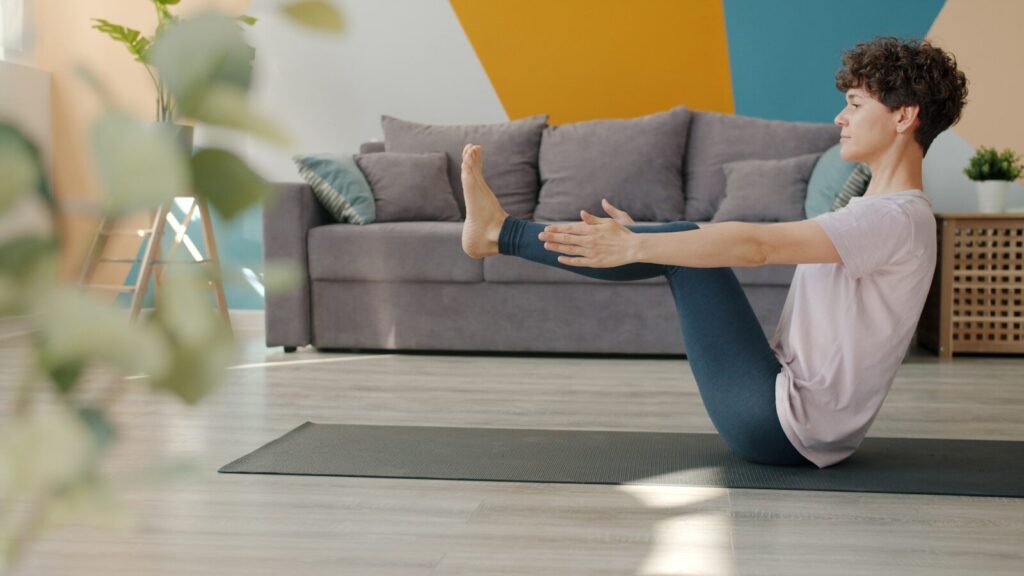
On days when you are not performing your full routine, resist the urge to remain completely sedentary. “Passive rest” (sitting still) often makes muscles stiffer. “Active restoration”—such as a brisk walk, gentle yoga flows, or practicing balance poses—increases blood flow. This accelerated circulation flushes metabolic waste from your muscle tissues, which is essential for feeling refreshed and ready for your next session.
Common Mistakes to Avoid
Even when training at home, you can make mistakes that stall your progress:
- Training by “Feel”: Don’t do what you feel like doing, do what you have to do. Follow a written routine, just like the one we proposed above.
- Skipping the Warm-up: Training in your pajamas without waking up your joints is the perfect recipe for injury. Dedicate 5 minutes to joint rotations (neck, shoulders, wrists, ankles) and some light cardio.
- Not Tracking Progress: If you don’t write down how many reps you did, you won’t know if you are improving. Use a simple notebook or the notes app on your phone to record your numbers for every session.
Conclusion: Your Gym is Wherever You Are
The difference between someone who achieves results and someone who gives up is not the equipment they have at home, but the discipline with which they execute their plan. Home workouts are, without a doubt, one of the purest forms of training: no distractions, no waiting, and completely focused on the movement.
Start today with the table we provided. Just strive to improve, not to be perfect. Do you have any questions about how to execute one of the exercises? Leave us a comment and we will help you correct your technique!